I am delighted to have the chance to join the happy crew at Shoreham Art Gallery and look forward to meeting all our visitors on my duty days. I would like to introduce myself by way of one of my favourite Instagram hashtags…. #crackplants.
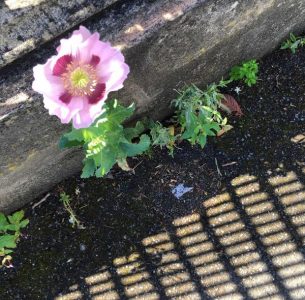
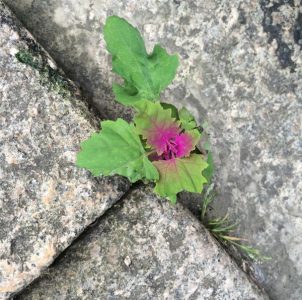
I am rather charmed by plants that grow in cracks and my eye has been drawn to them for quite a few years. I became especially obsessed during lockdown times. As I was pounding the local pavements, doing my daily ‘government sanctioned’ exercise, I was often pausing to admire some amazing specimens. I even awarded a few streets a prize for ‘best crack plants’ (in my head obviously).
“ I’ve always lived in cities and am drawn to abandoned buildings and spaces. I suppose I enjoy the aesthetics of urban decay and nature making best of the seemingly infertile surroundings. ”
Highlights included an enormous foxglove growing in a crack at the base of a lamppost and a huge clump of euphorbia emanating from a wall in Cornwall Gardens, which is a trophy-winning street near me.
I’m not brilliant at remembering plant names but there are some stand out heroes of the crack scene including, the Erigeron karvinskianus daisy and the blooming glorious Hollyhocks who seem to love an impossible situation.
What I find alluring about these resourceful plants is their rebellious nature, fighting against adversity, I love to imagine humans disappearing and plants taking over as soon as possible. I’ve always lived in cities and am drawn to abandoned buildings and spaces. I suppose I enjoy the aesthetics of urban decay and nature making best of the seemingly infertile surroundings. These observations seed themselves into a lot of my work.
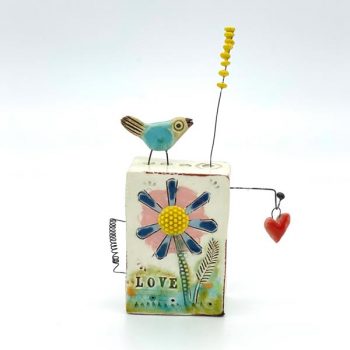
When making my tiles and ‘ceramic blocks’ I press red or black clay into plaster moulds. I then paint many layers of white slip onto the pieces. After the slip has dried to my favourite ‘leather hard’ state I draw into the clay and make marks using ‘found’ objects. I like to keep some of the drawing marks, allowing the ‘history’ of the marks to be visible and pulling the red or black clay back to make it look a bit distressed. I use a special wire that can survive in the kiln for a bit of extra movement.
I hope next time you walk past a plant surviving in a crack you will give it some love too.