For some sculptors once they have finished working on a form, and they wish it to survive for future study or installation in the environment, CASTING is the process they turn to. This might mean handing the sculpture over to a casting workshop or foundry for a mould to be made and then filled with their chosen material, and a choice of finishes applied with the advice of the casters in the industry. This can be a very expensive undertaking due the hours of work involved.
Magic of silicon rubber mould making progress
First rubber going onto Abby Martins Pupae
However, if considered as a furthering of experiment, and exploration of materials, amazing discoveries of an original and more personally expressive nature can be developed. I have never tired of the magical elements of the casting process.
The transformation of a form from one substance, e.g. clay, plaster, Plasticine, wax, found objects or all combined, into a completely different material, is a human action of WONDER. There will always be some tales of the unexpected. Maybe a chemical reaction of 2 substances in contact or the result of differences in temperature or humidity at certain stages. Sherlock Holmes’ hat hangs in readiness on our workshop wall to investigate the CURIOUS and the FASCINATING as they occur, together with an ever increasingly large magnifying glass as the years have passed.
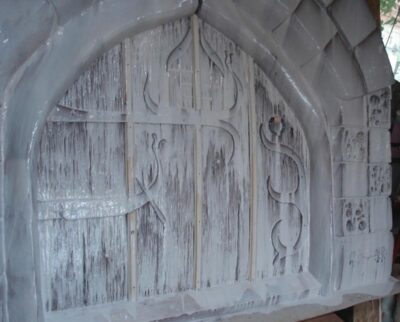
First layer on Adur Portals large relief - Martin Sculpture
For 40 years I have been interested in and practised casting sculptures in a variety of materials, pushing the process to stretch the possibilities. There are some parts of the process that are fiddly, laborious, scratchy, smelly and impossibly sticky. But as they are my own forms and ideas emerging it doesn’t feel like the penance it would be if I was given the job by someone else.
Detail of Adur Portals cat flap with rubber on
Materials available to make moulds and fill them have changed enormously and new products are constantly advertised. I have written many process sheets and leaflets about types of casting in the past. They become very long once step by step information is required. These days much can be gleaned by keen students viewing Youtube to give a clue what to do, but the process takes time and things need to set in between stages. Students complain that the videos don’t give all the info they need to feel confident to have go themselves and the materials can be very expensive to gamble on their success. Attending my classes, students develop skills and gain confidence by practicing before they overspend. Sculptors who do cast their own or other people’s works will have their favourite methods and materials.
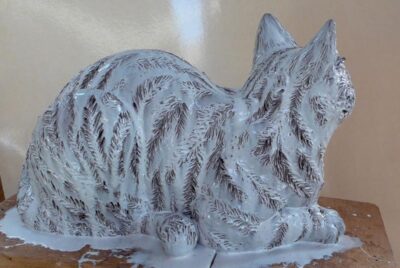
First rubber layer on Ginger Copper Cat - Teresa Martin
Here is not the place to try overload a blog with process info. Instead I will share a little of the sense of casting magic felt in Martin Studios over the years. Part 2 of this blog will reveal some of the discoveries and results from students’ experiments with types of rubber over the years. Without doubt, my favourite bit is the application of the first layer of silicon rubber over a finished form, especially when the colour of the master contrasts with the rubber. The concept of the work takes on new meanings as the rubber, with the consistency of condensed milk, drips down the form, creeping into texture marks and forming runs and puddles. There is also the huge relief at this stage that all the general decision-making about the shape of the form has been done. It can’t be undone without scrapping the piece and wasting the rubber. The worst crisis at this point would be to have forgotten to add the setting catalyst of course. That would be very messy.
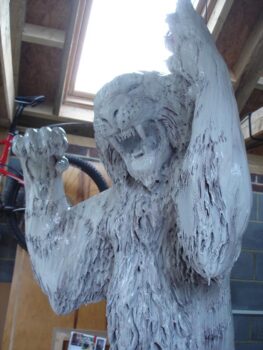
First layer on Territorial Tiger-Martin Sculpture
Detail of rubber dripping on Tiger-Martin Sculpture
The rubber forms a made-to-measure waterproof coating, so the work doesn’t need to be wrapped in plastic anymore to be kept evenly moist and it won’t shrink or crack beyond this stage if all covered with the rubber. This is one of the reasons I like using T20 RTV rubber. Some people use thick paste-like rubber (with thixo additive) which doesn’t run into the texture with gravity, so they miss out, tragically, on the magic of the DRIP !!! Using T20 also means you can reinforce the walls of a rubber mould with muslin so that it can’t tear. This method also makes it easier to peal back the sections of the rubber to de-mould the sculpture once rubber and supporting jacket are complete as the rubber isn’t so chunky. Many people find their fingers are not strong enough to cope with bending back thick rubber moulds.
Other methods of making a rubber mould involve pouring the rubber inside a completed supporting jacket, filling a gap between form and jacket (or a poured blanket mould). This also can create thicker sections of rubber hard to pull back and any exciting dripping and creeping of rubber into texture is done out of sight. Such a loss ! And as the rubber can’t creep upwards into any texture marks under any over hanging forms texture is lost or air bubbles can occur. Bring on the magic of the drip!
Here we are showing some of the works that we managed to photograph in the first layer of rubber, drippy stage. If you use this process, please share some images or videos of your dripping with us at #abbymartinsculpture
Painting further layers of T20 rubber application
All layers of rubber and muslin applied on Territorial Tiger for London Zoo
Making the supporting jacket for Territorial Tiger - Teresa Martin